



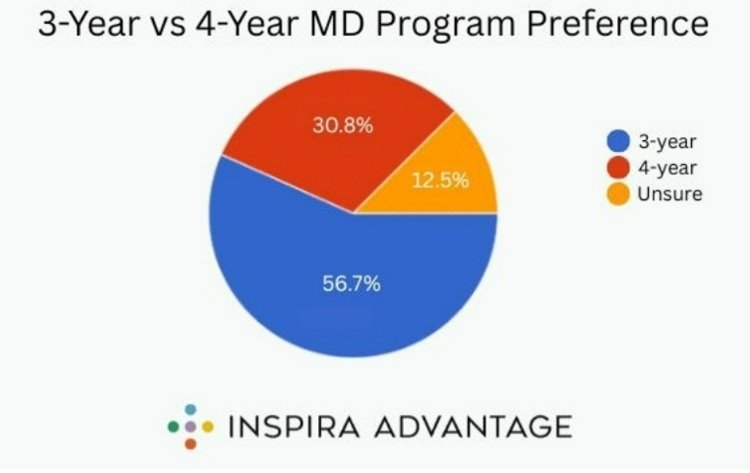
A recent survey conducted by Inspira Advantage has revealed a significant preference among aspiring and current medical students for a three-year medical school program over the traditional four-year curriculum. Out of 224 participants, 56.7% favored the shorter program, primarily motivated by concerns related to student debt.
Regarding the findings, 82% of students opting for a three-year MD program cited cost reduction as their main motivation. As the financial burden of medical education increases, with the median expenses reaching over $297,000 for public institutions and surpassing $400,000 for private ones, these preferences reflect a growing urgency driven by financial pressure. Starting in July 2026, new federal restrictions on borrowing will further limit graduate student loans, imposing a cap of $50,000 annually and a total lifetime limit of $200,000, while Grad PLUS loans will be eliminated.
Among the survey respondents, 66.5% indicated that these borrowing caps would encourage them to consider three-year programs. More than 30 U.S. medical schools already offer such accelerated pathways, which could address not only the financial concerns but also the physician shortage predicted to reach up to 86,000 by 2036.
Although the interest in three-year programs is notable, concerns remain regarding training quality, competitiveness for residency placements, and preparedness for clinical practice. Notably, 60.6% of respondents feared that the accelerated pace might compromise educational rigor.
With financial realities shaping student preferences, experts stress the importance of ensuring that any shortened program maintains quality while also addressing student well-being and fostering adequate preparation for future physicians.
Why this story matters: The shift towards three-year medical programs reflects mounting financial pressures on students and the need for more accessible educational pathways in medicine.
Key takeaway: A significant number of medical students are increasingly leaning toward accelerated MD programs due to student debt concerns and federal borrowing limitations.
Opposing viewpoint: Critics emphasize the risks of reduced educational quality and preparedness in accelerated programs, questioning whether shortening training could compromise competency and future healthcare quality.