



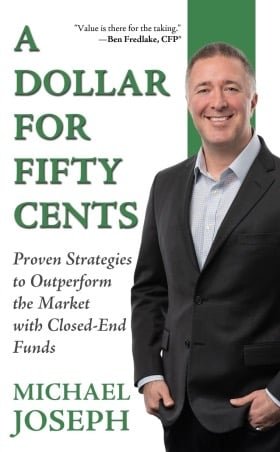
Michael Joseph, CFA, explores the nuances of investing in closed-end funds (CEFs) in his book, A Dollar for Fifty Cents: Proven Strategies to Outperform the Market with Closed-End Funds. He argues that these funds are often mispriced by the market, cautioning investors against the simplistic approach of purchasing funds merely based on deep discounts or high yields. Joseph emphasizes that hoping for intervention from activist investors to correct pricing discrepancies is speculative and fraught with risk.
The book acknowledges the challenges posed by market fluctuations, particularly highlighting the effects of the Federal Reserve’s interest rate hikes in 2022, which severely impacted the valuations of several leveraged municipal bond CEFs. Joseph references the well-known case of Warren Buffett and Charlie Munger’s investment in Source Capital during the market downturn of 1969-1970, illustrating how significant discounts to net asset value (NAV) can occur, though they are not consistently available.
Joseph lays out a more pragmatic strategy: investing in CEFs at a 20% discount to NAV, with the intent to sell when the discount reduces to 15%. He makes the book accessible to both nonprofessionals and financial professionals less familiar with CEFs, summarizing existing literature on their perceived market inefficiencies and elucidating the relatively new structures of CEFs with specified termination dates.
While Joseph references studies indicating that CEFs can yield superior returns, he advises readers that they may not find a clear path to consistently outperforming the market. Nonetheless, he posits that CEFs can offer meaningful diversification and income generation, making them a worthy consideration in an investment portfolio.
Why this story matters:
- CEFs present unique investment opportunities and risks that require careful analysis.
Key takeaway:
- A more strategic approach to CEF investment focuses on specific discount levels rather than high-yield attraction.
Opposing viewpoint:
- Some investors believe CEFs provide automatic value due to perceived mispricing, which can lead to overestimating potential returns.