



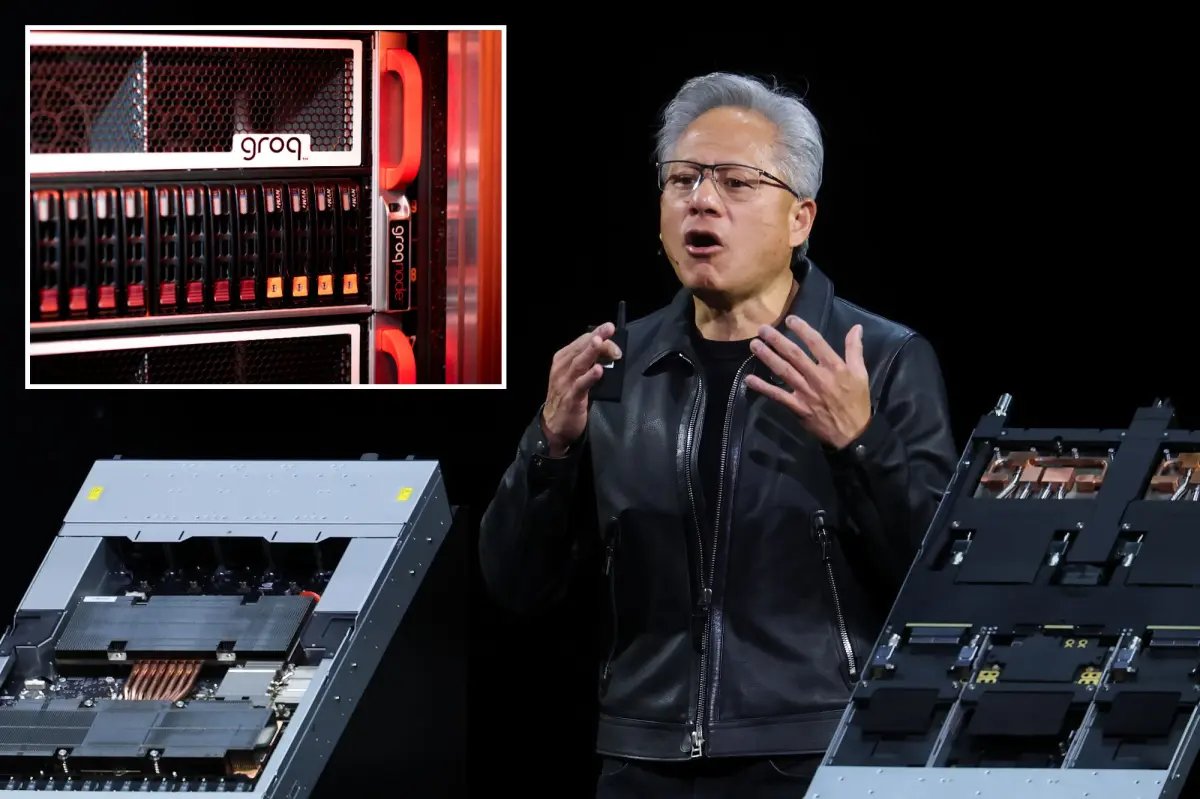
Nvidia has entered into a licensing agreement with Groq, a startup specializing in AI inference technology. As part of the deal, Nvidia will recruit Groq’s CEO, Jonathan Ross, who has notable experience from his past role at Google’s AI chip program. Groq made the announcement in a recent blog post, highlighting that the licensing arrangement is “non-exclusive.”
Despite Nvidia’s stronghold on the market for training AI models, it faces increasing competition in the inference sector from established firms like Advanced Micro Devices, as well as emerging players such as Groq and Cerebras Systems. Nvidia’s CEO, Jensen Huang, emphasized the company’s strategy to maintain its leadership position in AI, particularly as the market transitions from training to inference.
Financial details regarding the agreement were not disclosed, though prior reports suggested Nvidia might acquire Groq for approximately $20 billion. Nevertheless, Groq is set to operate independently under the leadership of Simon Edwards, with its cloud operations continuing as usual. The startup recently experienced a significant valuation surge, climbing to $6.9 billion from $2.8 billion following a $750 million funding round in September.
Groq distinguishes itself through its innovative use of on-chip memory called SRAM, which mitigates issues related to high-bandwidth memory shortages hampering the broader chip industry. This technology accelerates responses from AI models, although it may restrict the size of these models. Groq’s primary competitor using a similar approach is Cerebras Systems, which is reportedly preparing for an IPO next year.
– Why this story matters: The deal underscores Nvidia’s strategy to enhance its capabilities in the competitive AI inference market.
– Key takeaway: Groq continues operations independently while collaborating with Nvidia to leverage its inference technology.
– Opposing viewpoint: Some industry analysts argue Nvidia’s dominant position may stifle innovation among smaller players like Groq.