



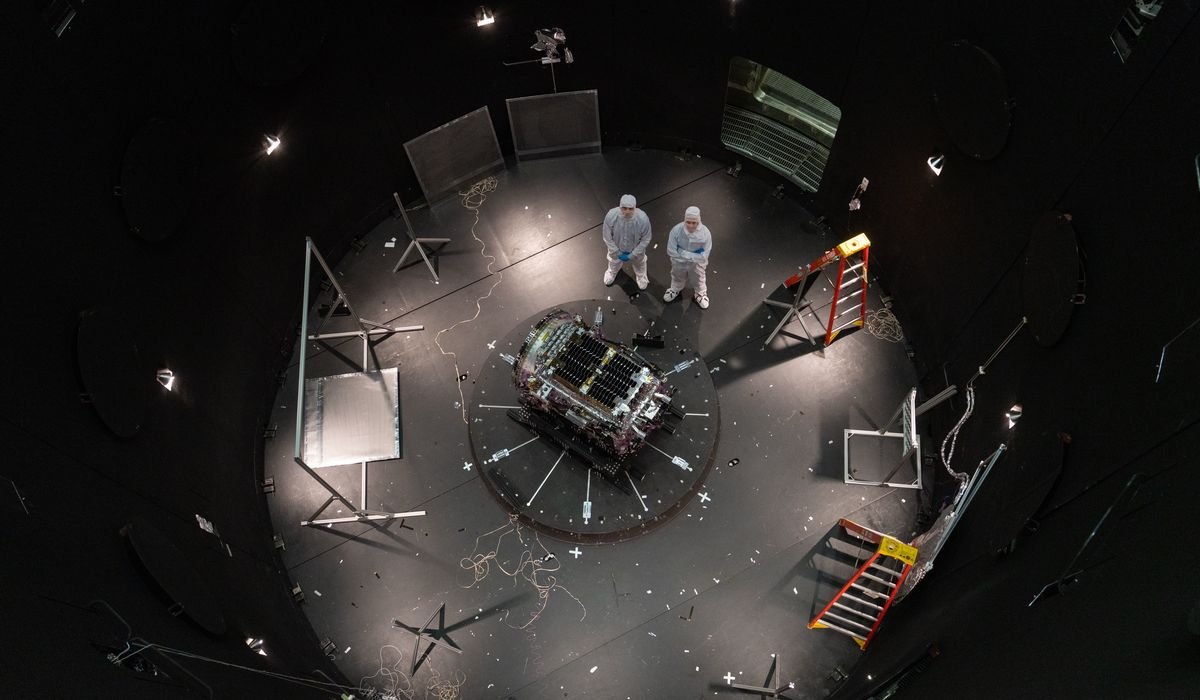
A three-armed spacecraft successfully launched into orbit on Friday to undertake a critical mission to save NASA’s Swift Observatory, which is at risk of crashing back to Earth. Northrop Grumman’s Link spacecraft lifted off from the Marshall Islands, propelled by a Pegasus rocket originating from a modified airplane. The mission aims to rendezvous with Swift in approximately one month.
Since its launch in 2004, Swift has been experiencing decreased altitude due to recent solar storms. In an effort to prevent its imminent demise, NASA is investing $30 million in Katalyst Space Technologies to capture the telescope and elevate its orbit. Swift, currently orbiting at 224 miles above the Earth, requires a boost of 150 miles to return to its original altitude and continue its vital observations of cosmic phenomena, including gamma-ray bursts and supernovae.
If the operation proceeds smoothly, Swift could resume its celestial observations by September. Currently, all observations are on hold to preserve the telescope’s orbit, which is expected to become too low for recovery by autumn. Without intervention, predictions indicate it could fall back to Earth as early as October.
Katalyst undertook this accelerated mission planning, completing it in just nine months, in response to NASA’s urgent request. A series of delays due to technical issues and inappropriate weather conditions caused last-minute challenges. Ghonhee Lee, CEO of Katalyst Space, emphasized the mission’s high-stakes nature, highlighting that failure to launch could result in Swift’s destruction.
Why this story matters: The successful rescue of Swift could ensure the continuation of vital astronomical research.
Key takeaway: Timely intervention by Katalyst and NASA may save the Swift Observatory from imminent demise.
Opposing viewpoint: Critics may argue that investing $30 million in salvaging aging technology diverts funds from newer projects.